Mountain TimePhoto Sharing and Video Hosting at PhotobucketPhoto Sharing and Video Hosting at Photobucket השעה בארץ ישראל

Thursday, December 31, 2009

Maybe America Needs to "Israelify" it's Airports?

(Hat tip to Rafi, Pesky Settler, and Jacob Richman on Twitter)

Our (and Europe's) ridiculous airport security measures and our incompetent intel gathering is still tinged with political correctness and knee-jerk reactions after every terrorist attempt. This is why Umar Farouk Abdulmutallab was allowed to board Northwest Flight 253 to Detroit in Amsterdam and attempt to blow it up and murder 300 people.

In this regard we in the U.S. have much to learn from Israel.

Israel airport security is simple and sensible. They do not greatly inconvenience passengers--unlike removing shoes, not allowing more than 3 oz. of liquids, or threatening to physically patting down every person attempting to board -- instead, they ask questions and watch your response , before you've even parked your car or gotten off your bus.

We in the U.S. shudder at the thought of "racial profiling?" This is what Rafi Sela, president of AR Challenges who has worked globally with airports, thinks of profiling in general:

"The word 'profiling' is a political invention by people who don't want to do security," he said. "To us, it doesn't matter if he's black, white, young or old. It's just his behaviour. So what kind of privacy am I really stepping on when I'm doing this?"
After going through five levels of security checks while approaching and entering Ben-Gurion airport, you then arrive at the body and hand-luggage check (which is the only one U.S. airports do). And the Israelis do it right:
"...But here it is done completely, absolutely 180 degrees differently than it is done in North America," Sela said.
"First, it's fast — there's almost no line. That's because they're not looking for liquids, they're not looking at your shoes. They're not looking for everything they look for in North America. They just look at you," said Sela. "Even today with the heightened security in North America, they will check your items to death. But they will never look at you, at how you behave. They will never look into your eyes ... and that's how you figure out the bad guys from the good guys."
Read the entire article here, and tell our President Barak Hussein O-bomber who said in his campaign "it's time for change" to make these security changes now, or be held responsible for the next attack on the nation he pledged to protect.

Take note, America; the next terrorist attempt to blow up your plane is only a flight away. . .


Stumble Upon Toolbar

Tuesday, December 29, 2009

HH and KCC - Forgot to Link Them (better late than never...)

I was reminded by Soccer Dad (although he doesn't know it) that I forgot to link to the last two Jewish Blog Carnivals, Haveil Havalim, so here they are, HH #248 at Frume Sarah's, and #249 at I'll Call Baila.
And here is the link to the KCC #49 (that's Kosher Cooking Carnival for you clueless ones) hosted this month at Kosher.com. Oh--almost forgot JPIX at Leora's.

Read, eat, look & enjoy!


Stumble Upon Toolbar

Blacks Women to the Back of the Bus!


I have written previously about Haredi segregated buses, and the abuse that is sometimes perpetrated against women who inadvertently sit in the front of the bus, instead of the rear where they belong, according to the Haredi view of the halacha (Jewish law) of modesty.  Some Haredi men will go so far as to verbally and emotionally abuse a woman who has sat in the front of the bus, if she refuses to move to the back.

Apparently some women are fighting back.  They have petitioned the Israeli Supreme Court to ban gender-segregation on public buses.  Transportation Minister Yisrael Katz is supposed to issue the government's verdict.  Let's hope he uses his שכל , and shows by his decision that Israel values mitzvot bein adam le-havero more than the humra-of-the-week.


Stumble Upon Toolbar

U.S. Tourists Forewarned: In Israel, Beware the Terrorist Israeli Driver

Many snows ago when we lived in Israel, I drove our trusty Citroën “station.”  Not only did I drive, but Israel is where I learned to drive a stick shift.

I will never forget stalling at a 5-point intersection (I think it was in the Emek Refaim neighborhood of Jerusalem), with El Busso-Biggo breathing down my neck to the right, and irate drivers in front, behind and on the side, screaming obsenities and honking at me—and I was so nervous, I couldn’t start the d---mn car!

When I visited Israel in 2005 after twenty-four years being away, I was appalled at the driving; if anything, it had gotten worse, because of the increased congestion.  I actually got behind the wheel once and tried driving in Petach Tikva onto the highway, but with poor signage and aggressive, honking and tail-gating drivers, I couldn't continue.  I actually pulled over on the shoulder of the highway (I was lucky there was a shoulder) and told my son to take over (ok, I'm a wimp).  Since then I have never driven there, and honestly don't know how I will get up the gumption to do so in the future. 

Well, folks, it wasn’t just me:  (as seen on JTA, from YNet) it looks like the U.S. State Department Travel site has gotten wind of this, and is warning American tourists about the Israeli driver, as well as some other things, not all of which I agree with.  Here's an excerpt.  Read the whole article here.

Aggressive driving is a serious problem in Israel, and many Israeli drivers do not obey traffic laws – they don't keep a save driving distance and don't signal before changing lanes or turning.

This is what the US State Department thinks about Israelis and Israeli drivers according to its updated guide on the State of Israel for the American tourist visiting the country.  

The State Department continued: The Israeli driver tends to make sudden stops in the middle of the street without any forewarning, particularly in the right-hand lane. Drivers must exercise significant caution on Israel's roads, especially in light of the high number of traffic accidents that result in injury and the very congested streets, specifically in urban areas. . . 


Stumble Upon Toolbar

Monday, December 28, 2009

An Argument for Jewish Observance

I received a comment from "Anonymous" on my previous post, which was about the archeological find  of a 2000+ year old cave from the time of the Hasmoneans.  The commenter asked why that could be a reason to become a religious  Jew.  Good question.  To the average non-Jewish person, perhaps, the find might be interesting in a general way; to an archaeologist or historian, it would be interesting as a historical find which would validate and increase our knowledge of the past. 

For a Jew, however, such a find as this means so much more.

Look at it this way: we live today in the “Information Age,” right?  We are bombarded with information and have been for years, through the media--through radio, television and newspapers, and in our high-technology era on the Internet through virtual news sites, blogs and now social-networking sites such as Facebook and Twitter.  How can we assimilate all this? How do we know what is truth and what is fiction?  And, for that matter, how can we know how to behave, in general, and how to react to events?

Now, we Jews have been blessed with a ‘code book' which we've had for thousands of years, which tells us how to act, and tells us why we are here on this Earth.  This book is called the Torah.  It consists of the Written and the Oral Law, as well as the history of our people.

In our ‘modern’ times, however, people are constantly questioning and arguing religion versus science.  Which one offers the real explanation for the existence of the world? Now to me, there is very little contradiction between science and religion--they are one. Both science and the Torah are a means of explaining the truth of existence.  The more we learn things through scientific study (think 'Big Bang' and 'Quantum Theory'), the more we understand about the nature of G-d (can you tell I’m reading Gerald Schroeder’s books?), and the more it seems to (yikes!) match the depiction of G-d as written in the Torah.

But you'd never know it by listening, reading or watching debates on which one, science or religion, is “correct.” This can--coupled with global anti-Semitism towards Jews and Israel, (which according to many can ‘do no right’ in this world) really confuse one, especially someone who might be searching for the meaning of his existence.  Doubts abound.  Are any of the religions valid? Maybe Judaism is no more valid than any other major religion?

And then, a Jew goes to the kotel* and has a “spiritual experience.” Or a Jew goes to a grave of one of our Tzaddikim,* prays before the grave, and is greatly moved--by something—what? Or he visits and walks around, say, Emek ha-Elah,* where the future King David, as a young boy slew the giant Goliath, and he (the visitor) is in awe, and his soul is stirred.

Or, a secular Jew who went through life without a strong connection to his Jewishness, unearths a two-thousand-year-old cave while digging out his basement, which he discovers is the burial place of the last Hasmonean king.  Furthermore, the cave has an inscription on the wall in his people’s alt-neu language, the language in which his Torah was written, and which was revived in the twentieth century as a spoken language.  

Is that not awesome?  Is that not enough of a spiritual experience to touch one’s neshama*?  Is that not enough that it says to that Jew, ‘evidence of your history in your historical homeland  is before your eyes being unearthed and is unfolding, bit by bit, and proving that history true.  Jew: Is it not time to return?--to return to your Jewish roots?

If that is not enough of an experience for one's neshama to do teshuva,* I don't know what is.


*kotel: commonly known as the Western Wall, the last retaining wall of the Jews' Holy Temple, still standing for 2,000 years.

*tzaddikim: righteous sages

*Emek ha-Elah: the valley of Elah, or Terebinth, where David slew Goliath.

*neshama: soul

*teshuva: returning, depending upon context, sometimes meaning to one's religious roots.


Stumble Upon Toolbar

Wednesday, December 23, 2009

Archeological Find Proves Ancient Jewish Ties to The Land of Israel

I should have written about this on Chanukah, but time did not permit (hat tip to my older son, Mister A., for sending me this story) so I am posting it now.

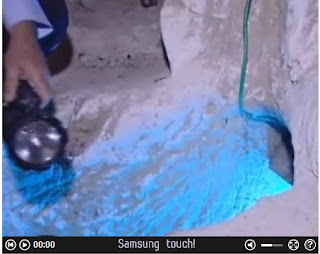
Those who say that Jews are usurpers in the land of Israel, need to see this video and read the story (the original is in Hebrew; translation below). In brief, a secular Israeli Jew was building his house in Jerusalem, when he accidentally, while digging out his basement came upon a cave five meters underground. It contained writings in ancient Hebrew, and what seems to be the burial place of the last Hasmonean king, Mattityahu ben Yehudah (Mattathias: not to be confused with Matityahu ben Yochanan, the father of Yehuda Maccabee). As a result of his findings, this secular Israeli Jew did teshuva ("returned") and became religious.

Hanukkah miracle: a secret burial cave was discovered in a garden house in Givat Hamivtar, Jerusalem. One hypothesis is that the burial cave belongs to none other than the last Hasmonean king, Matityahu Ben Yehuda. The cave was discovered quite by accident, when Rafael da Rosa decided to build a house on the hill. During the excavations, at a depth of five meters down in the cave were exposed two coffins containing a rare statement from the Second Temple. It is suggested in the statement that the person buried at the cave is Matityahu the Hasmonean.

Following the discovery De Rosa decided to repent [i.e., become religious]. "I came to this reality perhaps for the sole purpose of dealing with this cave," he says now, and feels that he is joined to this mission. "This is perhaps the most striking discovery in Israel's history," explains Dr. Yoel Elitzur, an expert researcher of Eretz Yisrael [i.e., the land of Israel].

He [Dr. Elitzur] claims that "all theories which previously negated the authenticity of the identification of Matityahu - have fallen, one by one." In the meantime, the cave has become the secret focus of pilgrimages for both secular and religious alike, in the belief that it contains within it mystical powers.
Those of you fortunate enough to read and understand Hebrew can go to the article and video on the Nana website.
Below are some screen shots of portions of the video depicting the cave.

The approximate translation of the ancient script, translated into modern Hebrew in the photo, bottom right, is:"

“I, Abah, son of the Priest Elazar son of Aharon the Great.

I Abah, the tortured and pursued, who was born in Jerusalem and was exiled to Babylonia, who brought up Mattityahu son of Judah and buried him in the cave

Which I bought with a bill of sale."


What we learn from the story above is simply this: archeological evidence is constantly being unearthed which proves that the Jews have ancient ties to the Land of Israel, from time immemorial. That Jewish history is true.

That there has always been a Jewish presence in the land, up to the creation of the State of Israel is a known fact. In modern times, the Jews have returned to their ancient land to create a national homeland for themselves. They, and they alone built up the land from swamp and desert to be a thriving, tehcnologically advanced and successful first-world country.

Finally, it is written in the Torah, the Bible that at least two major religions accept as Divine, that the modern day Land of Israel (whose Biblical borders far outreach Israel's current borders of today) was promised to the Jews.

Who has the audacity to say, that the land of Israel was originally "Palestinian" - 'Palestine' being the name given to Judea and Samaria by the Romans - and the Jewish People have no right to it?
We have every right in the world.


Stumble Upon Toolbar

A Comedic "Cut-Up" Worth Seeing

A very funny comedian currently featuring a one-hour show in New York has recently come on the scene. Born Chris Campbell, now Yisrael Campbell and living in Israel, the former lapsed Catholic and teenage alcoholic druggie who converted three times to Judaism (Hassidic in his final incarnation), is getting big laughs for his one-man show "Circumcize Me" now at the Bleeker Street Theatre.

The video is long (no pun intended), about 46 minutes, but worth it. This guy is FUNNY (it's all in the delivery), so sit down with a nice, hot cup of chicken soup, and vatch:


Stumble Upon Toolbar

Warning: Extremely UNkosher Food for Thought

Okay, I know I joked about my kiddees eating our home-made spinach latkes which I just froze, when they visit us just before the holiday of Passover starts because, of course, they--the latkes, not the kids--are not kosher for Passover?

I don't have nothin' on this, however:*


They can't spell, either.

Makes those old latkes look good, wouldn't you say? And, guess who sent me this? Correct: my Chief Chef, of course (see his blog at www.kosherkook.com).

*(Warning: viewer discretion advised, for un-tzniyusdik and absolutely gross content. Must be over 18 to view this, accompanied by a. . .EMT guy with blinders on. Blog Administrator not responsible for any physical or spiritual consequences to video-viewer.)

Alka-Seltzer, anyone?


Stumble Upon Toolbar

Monday, December 21, 2009

Some Chanukah Photos to Share


The last day of Chanukah was this past Shabbat. I have a lot of trouble transitioning from a chag* to a regular week; I never want to let go of the holiday: it is my connection with ha-olam ha-ruchani*, and I keep wanting to hang on. . .so it was just today that I uploaded my Chanukah pictures and am posting some of them here (and will share them on Me-ander, too).

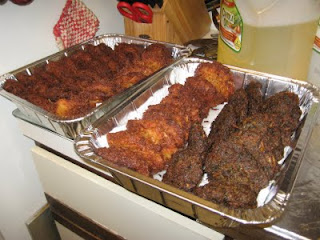
This year, unlike last year, I took plenty of pics, as we had a full chag (Baruch Hashem), including a friend's annual open-house, a Chabad family dinner and a party of our own on the 6th night, complete with home-made latkes, or levivot* in Hebrew (a joint venture) and home-made sufganiyot* (the Head Chef did it all by himself). It all culminated with a shared family-and-friends-Shabbat-dinner on the last night of Chanukah, at our home. Here are some of the highlights:

The two photos above are of our card table which annually morphs into a chanukiya table.

Our dining room table transformed into a Chanukah Party Table, presto, chango!

Just before lighting Shabbat candles (you can see the chanukiyot lit in the background) I snapped a pic of our Shabbat table set for our last-night Shabbat-Chanukah get-together, with one of my pull-apart challahs on the challah board.

. . .And, acharon, acharon chaviv*--for a special Chanukah treat, here is a video showing just a portion of our friends' children's "Chanukah Choir" (-because I didn't think of videotaping it until towards the end-silly me) which they created for our party, singing Hanerot Halalu*, Chabad style (kids, you are now famous!)

video


So how to exit gracefully from Chanukah? Why, look forward to our next upcoming holiday, Tu b'Shvat*!

But I've got one even better--our older son, Mister Arnold Mayergi and his lovely wife Hardally are (b'ezrat Hashem) actually coming to visit for the holiday of. . . Pesach*!! And guess what they're gonna get a couple of days before that holiday begins? You got it--leftover spinach latkes that we are freezing, because we made so many. Now, that's the way to hang on to a holiday, eh?!

*chag: holiday (Hebrew)
*ha-olam ha-ruchani: the spiritual world
*latkes: potato pancakes (Yiddish)
*levivot: potato pancakes (Hebrew)
*sufganiyot: jelly doughnuts, very popular in Israel during Chanukah
*acharon, acharon haviv: Hebrew for "last but not least." Literally means, "(the) last, (the) last (is most) loved."
*Hanerot Halalu: a prayer we say right after lighting the candles, explaining why we light them and thanking G-d for his miracles.
*Tu b'Shvat: the 15th of the Hebrew month of Shvat, commemorating the flowering of the trees, a harbinger for spring.
*Pesach: the holiday of Passover


Stumble Upon Toolbar

Thursday, December 17, 2009

"They Tried to Kill Us. . .* "


The holiday of Chanukah is going splendidly so far (Baruch Hashem). We have had Chanukah party after party, get-together after get-together, and eaten home-made and store bought levivot ('latkes' for you Eastern European-type Yiddish folks) and sufganiyot (jelly doughnuts or "Bismarks" for you, uh, other folks. . .)
In addition, which actually was the highlight of the week, the sixth night of Chanukah--in Israel--it was the fifth day for us--we had the great treat of being with our children & grandchildren, albeit virtually, for their Chanukiyah lighting ceremony and songs. How, you ask? (thought you'd never).

Very simple: my younger son Nathaniel Blumenstein invited his brother, Mister Arnold Mayergi & his lovely wife Hardally & their baby sister Rambo to Jerusalem for that night's candle-lighting in their apartment (or flat, for you Europeans).

N.Blumenstein ( he can cook, a little like his Abba) had fried yummy levivot for the occasion, and all was ready. Then--ON went the webcams on both sides of the ocean, connected to their respective computers, and PRESTO! There were my kids, all three of them who lived in Israel, with one daughter-in-law (Noodles, N.B.s wife) and their two lovely children, Googles and Tiddly, the new baby, also Big Bro Mister Arnold (his wife Hardally couldn't come as she was home slightly ill; we missed her...), and the Bros' baby sister--complete with short M16 slung over her shoulder--Rambo.

Then, the ceremony: Younger Bro N. Blumenstein sang the brachot in a clear, beautiful voice, and we, Abba and Eema (who also are Saba & Savta) answered "Amen," across the ocean. . . then they all sang "Haneirot Halalu" in the niggun that I taught them many, many years ago and with which they grew up. We sang that melody every Chanukah, for over forty years, in harmony (when the kids were old enough to harmonize). Afterwards, they sang "Maoz Tzur" (yes, all 6 verses), and a song we used to sing, also from my old High School Alma Mater, in English: "He Struck the Traitor to the Earth."

I was praying that another, modern-Chanukah miracle would happen right then and there, de-materialize me in a flash and re-materialize me 7,000 miles to the East, right into N.'s living room in Jerusalem. I squeezed my eyes very very tightly and prayed. It didn't.

After the lighting, the blessings, the singing--they all sat down to eat those yummy levivot that N.B. made. Rambo tried to push one into the webcam but I couldn't taste it. Sigh.

It was wonderful seeing them and semi-participating. We should have been there.

Instead, we made our our Chanukah party that night with close friends in place of family. Hubby and I made our own yummy levivot, including my mother's (a"h) famous spinach latkes, a veritable melt-in-your-mouth artform. And, singlehandedly ('cause I didn't have any heshek...) Hubby made sufganiyot and injected them with jelly, using the new cake decorator he recently bought just for that purpose.
It's interesting, the gender role-reversal we have in our family: Hubby is the Chief Chef, CFO & Organizer, whilst LL is more the Torah Educator and Ritual Director/ChoirMeister. But hey, whatever works.

Everyone seemed to really enjoy themselves, and one family's little kids treated us to a choir and piano recital! Toys and food and sevivonim (dreidels) were strewn around; I still haven't cleaned everything up, I think because I still want to remember the warmth and the happiness (nah, it's because I'm lazy).

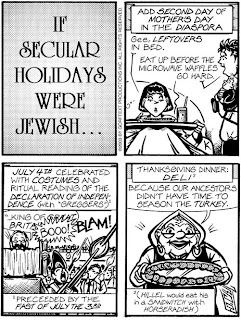
You know the old joke: Jewish holidays all boil down to the same theme: "*They tried to kill us, we won--Let's Eat!"

As long as we don't overdo it on the "EAT" part, we'll be OK. Happy Chanukah.

(cartoons by Jordan B. Gorfinkel as seen on JWR's site, here.)

*Copyright alert: No infringement of any text or graphic copyright is ever intended on this blog. If you own the copyright to any original image or document used for the creation of the graphics or information on this site, please contact the blog administrator with all pertinent info so that proper credit can be given. If you wish to have it removed from the site, just say the word; it shall be, ASAP.


Stumble Upon Toolbar

Sunday, December 13, 2009

The Essential Oils of Chanukah

(As seen on Not Quite Perfect)
Did you know that Chanukah is good for your health? Just pop a pill to get your essential Chanukah OIL; or better yet, just light the menorah. . .


Stumble Upon Toolbar

Friday, December 11, 2009

Jerusalem Chanukah

14 - Enchanting Lights of Hanukkah in Jerusalem
This is where I really want to be, this Chanukah and every Chanukah hence. Meanwhile, let's Distribute the light. Chag Urim Sameach!


Stumble Upon Toolbar

A Knockout of a Speech by Andrew Roberts

I first saw this at Daled Amos, who re-posted it from The Spectator's Melanie Phillips, who herself had reproduced the speech in its entirety without comment.

This speech was delivered by historian Andrew Roberts at the annual dinner of the Anglo-Israel Association. It is a no-holds-barred retelling of the history of Britain's behavior and attitude towards Israel, from the time of the Balfour Declaration in 1917.

Read the entire speech. The bottom line is, the only way Israel will get through the crises with all her enemies is with her own conviction, determination and strength, and the help of G-d.

Other than that, Israel can count on no one.

(In Melanie Phillips' words): Yesterday evening, the historian Andrew Roberts delivered a remarkable address at the annual dinner of the Anglo-Israel Association. I reproduce it here in full, with no further comment.

My Lords, Ladies & Gentlemen,

It’s a great honour to be invited to address you, especially on this the 60th anniversary of AIA, and I’d like to take the opportunity of this anniversary to look at the overall story of the relationship between Britain and Israel, and to try to strip away some of the myths.

Because it seems to me that for all the undoubted statesmanship implicit in Arthur Balfour’s Declaration of November 1917, promising ‘a National Home for the Jewish People’, it doesn’t mean that Britain has ever been much more than a fair-weather friend to Jewish national aspirations. The Declaration itself was at least in part conceived to keep Eastern European and Russian Jews supporting the Great War after the Bolshevik Revolution, and Chaim Weizmann’s preferred wording of ‘a Jewish State’ was turned down by the British Foreign Office. As David Ben-Gurion wrote at the time: ‘Britain has made a magnificent gesture … But only the Hebrew people can transform this right into tangible fact: only they, with body and soul, with their strength and capital, must build their National Home and bring about their national redemption.’

Sure enough, at the Versailles Conference and its ancillary meetings up to 1922, although Britain was given the League of Nations Mandate for Palestine, the Jewish National Home was not established. During the Mandate period there was an observable tension between the CO, which was responsible for administering Palestine and wanted to do so within the terms of the (admittedly self-contradictory) Balfour Declaration, and the FO, which feared that allowing the de facto creation of a Jewish State would alienate Arabs. In 1937 the Peel Commission recommended ending the Mandate and partitioning Palestine into Arab and Jewish states, with population transfers of 225,000 Arabs from Galilee, an outcome Ben-Gurion said [quote] ‘could give us something which we have never had, even when we stood on our own during the days of the First and Second Temples’. Nonetheless, both the Arabs and the 20th Zionist Congress rejected Peel’s recommendations, to the palpable relief of the Foreign Office, which concentrated its own opposition to it on the basis of its supposed impracticality.

Instead there was the notorious 1939 White Paper, which severely limited Jewish immigration into Palestine at precisely the period of their greatest need, during the Final Solution. A total upper limit of 75,000 Jewish immigrants was set for the fateful years 1940-44, a figure that was also intended to cover refugee emergencies. The White Paper was published on 9 November 1938 – the very same day as the Kristallnacht atrocities in Germany – and was approved by Parliament in May 1939, a full two months after Hitler’s occupation of the rump of Czechoslovakia. The Manchester Guardian described it as ‘a death sentence on tens of thousands of Central European Jews’, which in sheer numerical terms was probably an underestimation. Although the Labour Party Conference voted to repeal the White Paper in 1945, the Labour Foreign Secretary Ernest Bevin – a bitter enemy of Israel - persisted in it, and it was not to be repealed until the day after the State of Israel was proclaimed.

In late April 1948, Bevin ordered that Arab positions in Jaffa needed to be protected from the Jews [quote] ‘at all costs’, and when Israeli independence came the next month, the departing British sometimes handed over vital military and strategic strongpoints to the five invading Arab armies, the most efficient of which, Transjordan’s Arab Legion, was actually commanded by a Briton, Sir John Glubb. And then on New Year’s Eve 1948 the British Government actually issued an ultimatum to Israel threatening war if Israel did not halt its counter-attacks on Egyptian forces in the Gaza Strip and Sinai. Britain was the only country in the UN that came to Egypt’s aid in this regard.

One can easily see, therefore, why when Brig-Gen Sir Wyndham Deedes set up the Anglo-Israeli Association only weeks after Israel was finally recognized by Britain in 1949 - months after America, Russia and several other states had already done so – it was much-needed. There was still massive resentment over the War of Independence; Israel was considered at best a headache by the FO; and worst of all, unlike her neighbours, she had no oil. Nor did the Suez Crisis much help matters seven years later: the way in which Israel fitted in neatly with British plans to crush Nasser ought to have endeared her to the Foreign Office, but of course it didn’t.

When in May 1967 Nasser announced the blockading of the Straits of Tiran, closing Israel’s commercial lifeline to the east, the guarantors of this international waterway – including Britain – failed to act quickly or decisively, and although Harold Wilson was proud of his pro-Israeli sentiments, his foreign secretary George Brown and the FO certainly did not reciprocate them. Britain compounded its generally lukewarm attitude during the Six Day War by sponsoring Resolution 242 at the end of it, which called on Israel to withdraw [quote] ‘from territories occupied’, in a resolution that was so badly worded by the FO that Arabs and Israelis have been able to argue over its proper meaning ever since.

The Yom Kippur War of October 1973 saw even worse bias by the FO in favour of the Arabs and against the Jews. Announcing an arms embargo ‘equally’ between the belligerents, the Heath Government effectively stopped Israel buying spare parts for the IDF’s Centurion tanks, whilst allowing them to be bought by Jordan, the only other country affected, because it was not (officially at least) a belligerent. Egyptian helicopter pilots continued to be trained in Britain, with the foreign secretary Sir Alec Douglas-Home lamely telling the Israeli Ambassador that it was better for the pilots to be training in Britain than fighting at the front. Heath even refused to allow American cargo planes taking supplies to Israel to land and refuel at our bases on Cyprus.

In the 1980s Margaret Thatcher seemed to offer a new warmth to Anglo-Israeli relations. She sat for Finchley, her Methodism chimed well with Jewish values, and she was the most philo-Semitic PM since Churchill, yet even she was stymied by the FO, especially over Intelligence cooperation with Mossad. It’s true that John Major sent a special SAS unit to seek and destroy Iraqi Scud missile batteries targeting Israel during the First Gulf War, but that was largely to remove the danger of Israel retaliating, and thereby perhaps destroying the Arab coalition against Saddam.

After 9/11 Tony Blair seemed to appreciate how Israel was in the very front line in the War against Terror, and he thus bravely refused to condemn Israel’s acts of self-defence in Lebanon, but since then Britain’s contribution to the EU’s strand of negotiating over Iran’s nuclear ambitions has been, frankly, pathetic.

One area of policy over which the FO has traditionally held great sway is in the question of Royal Visits. It is no therefore coincidence that although HMQ has made over 250 official overseas visits to 129 different countries during her reign, neither she nor one single member of the British royal family has ever been to Israel on an official visit. Even though Prince Philip’s mother, Princess Alice of Greece, who was recognized as "Righteous Among the Nations" for sheltering a Jewish family in her Athens home during the Holocaust, was buried on the Mount of Olives, the Duke of Edinburgh was not allowed by the FO to visit her grave until 1994, and then only on a private visit.

"Official visits are organized and taken on the advice of the Foreign and Commonwealth office," a press officer for the royal family explained when Prince Edward visited Israel recently privately - and a spokesman for the Foreign Office replied that [quote] ‘Israel is not unique" in not having received an official royal visit, because [quote] ‘Many countries have not had an official visit.’ That might be true for Burkino Faso and Chad, but the FO has somehow managed to find the time over the years to send the Queen on State visits to Libya, Iran, Sudan, Kuwait, Bahrain, Qatar, the United Arab Emirates, Oman, Saudi Arabia, Tunisia, Algeria, Morocco, Jordan & Turkey. So it can’t have been that she wasn’t in the area.

Perhaps Her Majesty hasn’t been on the throne long enough, at 57 years, for the Foreign Office to get round to allowing her to visit one of the only democracies in the Middle East. At least she could be certain of a warm welcome in Israel, unlike in Morocco where she was kept waiting by the King for three hours in 90 degree heat, or at the Commonwealth Heads of Government Meeting in Uganda the time before last, where they hadn’t even finished building her hotel.

The true reason of course, is that the Foreign Office has a ban on official Royal visits to Israel, which is even more powerful for its being unwritten and unacknowledged. As an act of delegitimization of Israel, this effective boycott is quite as serious as other similar acts, such as the academic boycott, and is the direct fault of the FO Arabists. Which brings us on to Mr Oliver Miles.

One of the reasons I’m proud to be an historian is that there are scholars of the integrity and erudition of Prof Sir Martin Gilbert and Prof Sir Lawrence Freedman who also write history. If people as intelligent, wise and incorruptible as they choose to be historians, then it must be an honourable profession. Let me quote to you, therefore, word-for-word, what a former British Ambassador to Libya and Greece, Mr Oliver Miles, wrote in The Independent newspaper less than a fortnight ago, commenting on the composition of the present Chilcot Inquiry into the Iraq War:

‘Both Gilbert and Freedman are Jewish, and Gilbert at least has a record of active support for Zionism. Such facts are not usually mentioned in the mainstream British and American media. … All five members have outstanding reputations and records, but it is a pity that, if and when the inquiry is accused of a whitewash, such handy ammunition will be available. Membership should not only be balanced; it should be seen to be balanced.’

Ladies and gentlemen, if that’s the way that FO Arabists are prepared to express themselves in public, can you imagine the way that they refer to such people as Professors Gilbert and Freedman in private? For the balance that Mr Miles is talking about here is clearly a racial balance, that only a certain quota of Jews should have been allowed on to the Inquiry.

Of course there’s a reason why ‘Such facts are not usually mentioned in the mainstream media’, of course, and that is because it is a disgraceful and disgusting concept even to notice the racial background of such distinguished public servants, and one that wouldn’t have even occurred to most people had not Mr Miles made such a point of it.

Because there are 22 ambassadors to Arab countries, and only one to Israel, it is perhaps natural that the FO should tend to be more pro-Arab than pro-Israeli. On occasion there are remarkably good British Ambassadors to Israel – your president, Sir Andrew Burns, was one such in the early 1990s – just as there are on occasion remarkably good Israeli Ambassadors to Britain, indeed we are fortunate to have one at the Embassy today in Ron Prosor. Overall, however, such men are swimming against the tide of an FO assumption that Britain’s relations with Israel ought constantly to be subordinated to her relations with other Middle Eastern states, especially the oil-rich ones, however badly those states behave in terms of human rights abuses, the persecution of Christians, the oppression of women, medieval practices of punishment, and so on.

It seems to me that there is an implicit racism going on here. Jews are expected to behave better, goes the FO thinking, because they are like us. Arabs must not be chastised because they are not. So in warfare, we constantly expect Israel to behave far better than her neighbours, and chastise her quite hypocritically when occasionally under the exigencies of national struggle, she cannot. The problem crosses political parties today, just as it always has. William Hague called for Israel to adopt a proportionate response in its struggle with Hezbollah in Lebanon in 2007, as though proportionate responses ever won any victories against fascists. In the Second World War, the Luftwaffe killed 50,000 Britons in the Blitz, and the Allied response was to kill 600,000 Germans – twelve times the number and hardly a proportionate response, but one that contributed mightily to victory. Who are we therefore to lecture the Israelis on how proportionate their responses should be?

Very often in Britain, especially when faced with the overwhelmingly anti-Israeli bias that is endemic in our liberal media and the BBC, we fail to ask ourselves what we would not do placed in the same position? The population of the United Kingdom of 63 millions is nine times that of Israel. In July 2006, to take one example entirely at random, Hezbollah crossed the border of Lebanon into Israel and killed 8 patrolmen and kidnapped 2 others, and that summer fired 4,000 Katyusha rockets into Israel which killed a further 43 civilians. Now, if we multiply those numbers by nine to get the British equivalent, just imagine what we would not do if a terrorist organization based as close as Calais were to fire 36,000 rockets into Sussex and Kent, killing 387 British civilians, after killing 72 British servicemen in an ambush and capturing a further eighteen? I put it to you that there is absolutely no lengths to which our Government would not go to protect British subjects under those circumstances, and quite right too. So why should Israel be expected to behave any differently?

There has hardly been a single year since Brigadier-General Deedes established AIA in 1949 when a speaker has not been able to say that Israel faced a crisis, and on some occasions – in 1956, 1967, 1973 and especially in the face of the present Iranian nuclear programme today – these were existential. At a time when Barrack Obama appears to be least pro-Israeli president since Eisenhower, the dangers are even more obvious. For there is simply no way that Obama will prevent Ahmadinejad, perhaps Jewry’s most viciously outspoken and dangerous foe since the death of Adolf Hitler, to acquire a nuclear Bomb.

None of us can pretend to know what lies ahead for Israel, but if she decides pre-emptively to strike against such a threat – in the same way that Nelson pre-emptively sank the Danish Fleet at Copenhagen and Churchill pre-emptively sank the Vichy Fleet at Oran – then she can expect nothing but condemnation from the British Foreign Office. She should ignore such criticism, because for all the fine work done by this Association over the past six decades - work that’s clearly needed as much now as ever before – Britain has only ever really been at best a fairweather friend to Israel.

Although History does not repeat itself, it’s cadences do occasionally rhyme, and if the witness of History is testament to anything it is testament to this:

That in her hopes of averting the threat of a Second Holocaust, only Israel can be relied upon to act decisively in the best interests of the Jews.


Stumble Upon Toolbar

Thursday, December 10, 2009

The Importance of a Name (or, What's in a Name, Part II')


I wrote last year about my new baby grandson and the name that my son and daughter-in-law chose for him after great deliberation and research.

This new baby grandchild in Yerushalayim waited until very close to Shabbat before her parents had made a final decision on her name, which heretofore on this blog will be Tiddly (her Aunt Toodles was flying high: she was sure that her brother named her new little niece after her.) I was pondering the significance of Tiddly’s name, not recognizing it as a name from the TaNaCH. It sounded like “the dew of G-d” to me (והמבין יבין ), and I was trying to get my head around it, when I found this very interesting spiritual explanation of the name, and liked it so much, decided to post about it.


First of all, let me say that we believe that a person's name is very important; it is already decided "in Heaven" what a child's name will be, even before conception, and the parents are given Divine insight in choosing the correct name, although they still have free will to choose. Raising children is one of the, if not the most important task a person can do in his or her life. It is not to be taken lightly; so too, should naming a baby be taken seriously as well.

This dvar is from Rav Uzi'el Eliyahu and was written in Tevet of 5764 (2003). He wrote that Tiddly is a beautiful, good name. The Dew of G-d, it refers to the hidden power that exists in Creation. For example, we see the rain when it falls--but not the dew: it is as if it is hidden. It has an inner power to revive, and to give strength and happiness of life forever. This is a strength that is needed by all, even the wealthy. Everyone yearns for the coming of the Dew, which gives life and gladness to all living things.


Each name has a special numerical value (the study of numerology) or "gematria," and it is said that each and every name has its own "pasuk" (verse) which expresses its hidden meaning. A great tool for figuring out gematria and finding relevant verses can be found on the wonderful Ohr Chadash website. The gematria of "Tiddly" is 54. One verse which has a word with the gematria of 54 is in Tehillim (Psalms) 46:13.

I personally like the verse after it, containing כל כבודה בת מלך פנימה , which can roughly translate to "the honor [dignity] of a princess is within." My son, Nathaniel Blumenstein has told me that Tiddly is already a very different type of infant than was her brother, Googles. Whereas he was wrinkly as a prune, fidgety and fussy and couldn't be put down for an instant, his new little sister is quieter and seems gentler, and sometimes she can fall asleep by herself. My son said, she is (he couldn't remember the English translation for this) "adinah." "Adinah" means delicate, or fine; he said that she's definitely a feminine baby.

May my new granddaughter Tiddly have a long and blessed life, and may she fulfill the purpose that G-d has given her, Amen, Ken Yehi Ratzon. . .


Stumble Upon Toolbar

Wednesday, December 09, 2009

Happy Birthday Month

What to write about? It’s not as if there is nothing; au contraire, we live in interesting times, as they say, for better and for worse (and often it seems as if it’s mainly for worse).

So instead of writing about the economy (what there is of it) and resultant increase in Aliyah to Israel, or the global increase in anti-Semitism and almost universal blame on Israel for…everything, or the potential suicide bomber thwarted by a vigilant (thank G-d) IDF army and security guards in Qalandiyah (my son perhaps one of them, as that is his territory), or Bibi’s capitulation to Washington by implementing the building freeze in Judea and Samaria (the so-called“settlements” in the “West Bank”)—instead, I’ll write about…my birthday!

Yes, I just had a birthday (good Lord, not another one), two, in fact: my Hebrew date is Yud-Dalet, the 14th of the month of Kislev (for those clueless, it is Kislev right now: the Chanukah month), and my secular birthday is December 7th, a day that will always, ahem, live in infamy, as the radio blasts out when it automatically comes on in the morning. On my birthday. Every year. You’d think I’d be used to it by now, right?

Anyway, this year my birthday was especially special; I mean, it is every year, of course-- but this year, my husband finally succeeded in pulling it off. Pulling what off, you ask? (I thought you’d never…)

We were at a lovely fahrbrengen, a Chabad get-together event at our local (only) kosher restaurant, in honor of the Jewish date of Yud-Tet Kislev (which is the 19th of Kislev), an auspicious day for Lubavitchers because of the release of Reb Shneur Zalman from prison in Russia. Our Rabbi announced the simchas (two shluchim including himself just recently had children and grandchildren), and the speaker, and then said that before the speaker, there is one other ‘simcha,’ someone's birthday (would you believe I was still sitting there, clueless? Believe it.)—and then the owner of the restaurant makes a grand entrance holding up a nice-sized birthday cake with yummy frosting and one candle (now you know my age). The rabbi led everyone in singing “Happy Birthday” (there were about 50 people there).


I was embarrassed, but secretly pleased. You have to understand, that the last time my husband tried to pull off the ‘surprise cake’ bit it was for our anniversary at another community event, and the caterers forgot to bring out the cake!

What was even more humbling is that the speaker, who had actually come into town for one of the other simchas, somehow worked the fact of my birthday into his dvar Torah, about the Alter Rebbe. All in all, it was a great evening, and the next day—to top it off—all my kids in Israel and in the States, and the grandkids—called me and sang (yes, sang) the birthday song to me in two languages (no, it’s not the same tune in Hebrew. There are at least three different Hebrew/Israeli birthday songs that I know, and they sang two of them.).

Now, that is a great birthday! And Chanukah starts Friday night. I love my birthday month!


ZingerBug.com


Stumble Upon Toolbar

Sunday, December 06, 2009

 
Creative Commons License

This work is licensed under a Creative Commons Attribution-Noncommercial-Share Alike 3.0 License.